Title: Into the Gray Zone: A Neuroscientist Explores the Border Between Life and Death
Author: Owen, Adrian
Call Number:616.849 O97I 2017
Book Description from amazon:
In this startling and thought-provoking book, which will remind readers of works by Oliver Sacks and Atul Gawande, a world-renowned neuroscientist reveals his controversial, groundbreaking work with patients whose brains were previously thought vegetative or non-responsive but turn out—in up to 20 percent of cases—to be vibrantly alive, existing in the “Gray Zone.”
Into the Gray Zone takes readers to the edge of a dazzling, humbling frontier in our understanding of the brain: the so-called “gray zone” between full consciousness and brain death. People in this middle place have sustained traumatic brain injuries or are the victims of stroke or degenerative diseases, such as Alzheimer’s and Parkinson’s. Many are oblivious to the outside world, and their doctors believe they are incapable of thought. But a sizeable number are experiencing something different: intact minds adrift deep within damaged brains and bodies. An expert in the field, Adrian Owen led a team that, in 2006, discovered this lost population and made medical history. Scientists, physicians, and philosophers have only just begun to grapple with the implications.
Following Owen’s journey of exciting medical discovery, Into the Gray Zone asks some tough and terrifying questions, such as: What is life like for these patients? What can their families and friends do to help them? What are the ethical implications for religious organizations, politicians, the Right to Die movement, and even insurers? And perhaps most intriguing of all: in defining what a life worth living is, are we too concerned with the physical and not giving enough emphasis to the power of thought? What, truly, defines a satisfying life?
This book is about the difference between a brain and a mind, a body and a person. It is about what these fascinating borderlands between life and death have taught us about being human.
My Read:
It's a good read. Unlike the other books I have read, I had to read this book from chapter one all the way to the last chapter so that I would have ideas what's been mentioned in the previous chapter.
Wednesday, March 28, 2018
Tuesday, March 20, 2018
March 2018 Read/2
Title: The Tale of the Dueling Neurosurgeons: the History of the Human Brain
Author: Kean, Sam
Call Number: 617.48023 K24T 2014
Book Description from amazon.com:
Early studies of the functions of the human brain used a simple method: wait for misfortune to strike-strokes, seizures, infectious diseases, lobotomies, horrendous accidents-and see how the victim coped. In many cases survival was miraculous, and observers could only marvel at the transformations that took place afterward, altering victims' personalities. An injury to one section can leave a person unable to recognize loved ones; some brain trauma can even make you a pathological gambler, pedophile, or liar. But a few scientists realized that these injuries were an opportunity for studying brain function at its extremes. With lucid explanations and incisive wit, Sam Kean explains the brain's secret passageways while recounting forgotten stories of common people whose struggles, resiliency, and deep humanity made modern neuroscience possible.
My Read:
As I close this book one of the cases stated in it stays with me. It's listed in the chapter named "Wiring and Rewiring." Pedro, father of Doctor Bach-y-Rita, suffered a massive stroke in 1959 and was left half paralyzed and speechless. George, Bach-y-Rita's brother who was also a doctor, refused to send their father to a nursing home suggested by the patient's doctors. George designed his own rehab regimen. George made Pedro crawl like an infant at first, learning how to move each limb again, before gradually working him up to his feet. Then he made Pedro do household chores such as sweeping the porch and scrubbing pots and pans. Pedro struggled and appeared to make little progress, but the repetitive motions eventually retrained his brain. Not only did he regain the ability to talk and walk, he also resumed his teaching job, remarried, and started hiking again. His brain proved plastic enough to reroute the cues for walking and talking around the ravaged tissue. Instead of routing signals from A to B, it now routed them from A to C and then C to B.--page 90
Author: Kean, Sam
Call Number: 617.48023 K24T 2014
Book Description from amazon.com:
Early studies of the functions of the human brain used a simple method: wait for misfortune to strike-strokes, seizures, infectious diseases, lobotomies, horrendous accidents-and see how the victim coped. In many cases survival was miraculous, and observers could only marvel at the transformations that took place afterward, altering victims' personalities. An injury to one section can leave a person unable to recognize loved ones; some brain trauma can even make you a pathological gambler, pedophile, or liar. But a few scientists realized that these injuries were an opportunity for studying brain function at its extremes. With lucid explanations and incisive wit, Sam Kean explains the brain's secret passageways while recounting forgotten stories of common people whose struggles, resiliency, and deep humanity made modern neuroscience possible.
My Read:
As I close this book one of the cases stated in it stays with me. It's listed in the chapter named "Wiring and Rewiring." Pedro, father of Doctor Bach-y-Rita, suffered a massive stroke in 1959 and was left half paralyzed and speechless. George, Bach-y-Rita's brother who was also a doctor, refused to send their father to a nursing home suggested by the patient's doctors. George designed his own rehab regimen. George made Pedro crawl like an infant at first, learning how to move each limb again, before gradually working him up to his feet. Then he made Pedro do household chores such as sweeping the porch and scrubbing pots and pans. Pedro struggled and appeared to make little progress, but the repetitive motions eventually retrained his brain. Not only did he regain the ability to talk and walk, he also resumed his teaching job, remarried, and started hiking again. His brain proved plastic enough to reroute the cues for walking and talking around the ravaged tissue. Instead of routing signals from A to B, it now routed them from A to C and then C to B.--page 90
Sunday, March 18, 2018
March 2018 Read
Title: The Scalpel and the Soul: Encounters with Surgery, the Supernatural, and the Healing Power of Hope
Author: Hamilton, Allan J. M.D.
Call Number: 617.48092 H217YH 2009
Book Description from amazon.com:
A Harvard-educated neurosurgeon reveals his experiences—in and out of the operating room—with apparitions, angels, exorcism, after-death survival, and the miracle of hope. For the millions who have enjoyed Proof of Heaven, Heaven is Real, To Heaven and Back, andGetting to Heaven—an inspiring tale from where the veil between life and death is often at its thinnest.
The Scalpel and the Soul explores how premonition, superstition, hope, and faith not only become factors in how patients feel but can change outcomes. It validates the spiritual manifestations physicians see every day and empowers patients to voice their spiritual needs when they seek medical help. Finally, it addresses the mysterious, attractive powers the soul exerts during life-threatening events.
Author: Hamilton, Allan J. M.D.
Call Number: 617.48092 H217YH 2009
Book Description from amazon.com:
A Harvard-educated neurosurgeon reveals his experiences—in and out of the operating room—with apparitions, angels, exorcism, after-death survival, and the miracle of hope. For the millions who have enjoyed Proof of Heaven, Heaven is Real, To Heaven and Back, andGetting to Heaven—an inspiring tale from where the veil between life and death is often at its thinnest.
The Scalpel and the Soul explores how premonition, superstition, hope, and faith not only become factors in how patients feel but can change outcomes. It validates the spiritual manifestations physicians see every day and empowers patients to voice their spiritual needs when they seek medical help. Finally, it addresses the mysterious, attractive powers the soul exerts during life-threatening events.
My Read:
Chapter Eleven is titled "Thread of Hope." It's about what happened to a young brain tumor patient when cruel message had hit home, when hope he had been hold was taken away. "Donald, you remember once you asked me to tell you straight when it was time to go fishing?" the doctor asked. Donald nodded and looked down at his feet. "Well, it's time. Now, Donald." Donald didn't look up. He just sat there with his head bowed with tears falling onto his lap.---page 139 The next morning Donald's mother called the doc telling him her son, Donald had expired during the night. He was gone. The doctor said on the same page that 'He is convinced Donald died that night because the hope that had sustained him was taken away. He mistakenly cut the thin thread of hope that had kept him alive and aloft.' Indeed, hope keeps a person strongly motivated and sustains powerful will to survive and live.
Chapter Thirteen is named "For the Love of God." It's a about child with poorly treated hydrocephalus and his grandmother who was suffering from IV stage of ovarian cancer.The grandmother was informed by her doctors that she only had 4 months to live and her grandson would never be "normal." But this grandmother who has strong belief and trust in God asked her doctors to pray with her and told her doctors that she expected her grandson to earn a wage, keep a checkbook, and marry and have a family. What happened after the conversation with her doctors was incredulous: Less than three years after she was declared unlikely to live more than four months, this grandmother attended her own doctor's funeral. Her grandson recovered intellectual abilities and makes birdhouses for a living. He also got married and his grandmother was at his wedding. The grandmother said the following to a group of cancer patients: You need to be a realist to believe in miracles, because one can only see the real truth with the heart and not with the eyes."--page 165
Chapter Twelve is titled "Singing in the Brain." It's about a neurologist named Norm Mueller. Dr. Mueller had a theory and observations on aphasia and singing. It seemed to him that there are different legions and areas in the brain to process functions of speech and singing. The author was treating a renowned researcher on Alzheimer's who was suffering from aphasia. This patient doctor had to give a speech in a ceremony to award him for his contribution in the Alzheimer's research. Delivery the award speech in singing earned him a standing ovation. ---page 151-152
I expect to reread this book in the future. It's a good read.
Sunday, February 25, 2018
February 2018 Read/4
Title: Into the Magic Shop: A Neurosurgeon's Quest to Discover the Mysteries of the Brain and the Secrets of the Heart
Author: Doty, James R. M.D.
Call Number: 617.48 D725I 2016
Book Description from amazon.com:
Growing up in the high desert of California, Jim Doty was poor, with an alcoholic father and a mother chronically depressed and paralyzed by a stroke. Today he is the director of the Center for Compassion and Altruism Research and Education (CCARE) at Stanford University, of which the Dalai Lama is a founding benefactor. But back then his life was at a dead end until at twelve he wandered into a magic shop looking for a plastic thumb. Instead he met Ruth, a woman who taught him a series of exercises to ease his own suffering and manifest his greatest desires. Her final mandate was that he keep his heart open and teach these techniques to others. She gave him his first glimpse of the unique relationship between the brain and the heart.
Doty would go on to put Ruth’s practices to work with extraordinary results—power and wealth that he could only imagine as a twelve-year-old, riding his orange Sting-Ray bike. But he neglects Ruth’s most important lesson, to keep his heart open, with disastrous results—until he has the opportunity to make a spectacular charitable contribution that will virtually ruin him. Part memoir, part science, part inspiration, and part practical instruction, Into the Magic Shop shows us how we can fundamentally change our lives by first changing our brains and our hearts.
My Read:
Lady Ruth's Four Tricks:
1-Relax your body
Breathe in through the nose and breathe out through the mouth. Close your eyes then relax/scan your body from toes to scalp then to your heart and the heart's muscles. Sit for some minutes before relaxing. Think about how you are sitting and imagine that you are looking at yourself. With intention remember the sense of relaxation, calmness, and warmth. Slowly open your eyes. Sit for a few minutes with eyes open and just be with no other intention or thought.
2-Calm/tame your Mind(20 to 30 minutes)
Focus on your breath
Focus on an object
Pick any word as the mantra and chant
3-Open your heart
Think of people and send unconditional love
4-Clarify your intent(10 to 30 minutes)
Visualization
The alphabet of the heart the author has:
C-Compassion
D-Dignity
E-Equanimity
F-Forgiveness
G-Gratitude
H-Humility
I-Integrity
J-Justice
K-Kindness
L-Love
Author: Doty, James R. M.D.
Call Number: 617.48 D725I 2016
Book Description from amazon.com:
Growing up in the high desert of California, Jim Doty was poor, with an alcoholic father and a mother chronically depressed and paralyzed by a stroke. Today he is the director of the Center for Compassion and Altruism Research and Education (CCARE) at Stanford University, of which the Dalai Lama is a founding benefactor. But back then his life was at a dead end until at twelve he wandered into a magic shop looking for a plastic thumb. Instead he met Ruth, a woman who taught him a series of exercises to ease his own suffering and manifest his greatest desires. Her final mandate was that he keep his heart open and teach these techniques to others. She gave him his first glimpse of the unique relationship between the brain and the heart.
Doty would go on to put Ruth’s practices to work with extraordinary results—power and wealth that he could only imagine as a twelve-year-old, riding his orange Sting-Ray bike. But he neglects Ruth’s most important lesson, to keep his heart open, with disastrous results—until he has the opportunity to make a spectacular charitable contribution that will virtually ruin him. Part memoir, part science, part inspiration, and part practical instruction, Into the Magic Shop shows us how we can fundamentally change our lives by first changing our brains and our hearts.
My Read:
Lady Ruth's Four Tricks:
1-Relax your body
Breathe in through the nose and breathe out through the mouth. Close your eyes then relax/scan your body from toes to scalp then to your heart and the heart's muscles. Sit for some minutes before relaxing. Think about how you are sitting and imagine that you are looking at yourself. With intention remember the sense of relaxation, calmness, and warmth. Slowly open your eyes. Sit for a few minutes with eyes open and just be with no other intention or thought.
2-Calm/tame your Mind(20 to 30 minutes)
Focus on your breath
Focus on an object
Pick any word as the mantra and chant
3-Open your heart
Think of people and send unconditional love
4-Clarify your intent(10 to 30 minutes)
Visualization
The alphabet of the heart the author has:
C-Compassion
D-Dignity
E-Equanimity
F-Forgiveness
G-Gratitude
H-Humility
I-Integrity
J-Justice
K-Kindness
L-Love
February 2018 Read/3
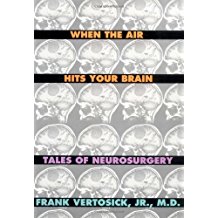
Title: When the Air Hits Your Brain: Tales of Neurosurgery
Author: Vertosick, Frank Jr., M.D.
Call Number: 617.48 V568W 1996
Book Description from amazon.com:
My Read:
Page 176-"The professor removed his glasses and began cleaning them slowly, squinting up at the high ceiling as he continued his dissertation.'These facts matter a great deal. What patient does for a living, what his background is, what level of education he has achieved...all of these issues must be addressed in great detail in order to put his complaints and his disease in the proper context. If I ask a man to take the square root of 100 and he cannot. I might take this as proof of a left-hemispheric brain tumor, unless I know he has worked on a farm since childhood and never attended school. Likewise, I might find it normal that a patient could not tell me the current exchange rate of the pound in Japanese yen. But if I knew that person was a merchant banker, on the other hand, ignorance of this fact would indicate a grave illness indeed! Americans have grown so dependent upon their scanning toys that they fail to view the patient as a multidimensional person. To have the audacity to cut into a person's brain without the slightest clue of his life, his occupation...I find that most simply appalling.'"
Personally, I found page 234 to page 238 very interesting in this book.
Author: Vertosick, Frank Jr., M.D.
Call Number: 617.48 V568W 1996
Book Description from amazon.com:
The story of one man's evolution from naive and ambitious young intern to world-class neurosurgeon.
With poignant insight and humor, Frank Vertosick Jr., MD, describes some of the greatest challenges of his career, including a six-week-old infant with a tumor in her brain, a young man struck down in his prime by paraplegia, and a minister with a .22-caliber bullet lodged in his skull. Told through intimate portraits of Vertosick’s patients and unsparing yet fascinatingly detailed descriptions of surgical procedures, When the Air Hits Your Brain―the culmination of decades spent struggling to learn an unforgiving craft―illuminates both the mysteries of the mind and the realities of the operating room.My Read:
Page 176-"The professor removed his glasses and began cleaning them slowly, squinting up at the high ceiling as he continued his dissertation.'These facts matter a great deal. What patient does for a living, what his background is, what level of education he has achieved...all of these issues must be addressed in great detail in order to put his complaints and his disease in the proper context. If I ask a man to take the square root of 100 and he cannot. I might take this as proof of a left-hemispheric brain tumor, unless I know he has worked on a farm since childhood and never attended school. Likewise, I might find it normal that a patient could not tell me the current exchange rate of the pound in Japanese yen. But if I knew that person was a merchant banker, on the other hand, ignorance of this fact would indicate a grave illness indeed! Americans have grown so dependent upon their scanning toys that they fail to view the patient as a multidimensional person. To have the audacity to cut into a person's brain without the slightest clue of his life, his occupation...I find that most simply appalling.'"
Personally, I found page 234 to page 238 very interesting in this book.
Thursday, February 15, 2018
February 2018 Read/2
Title: Attending: Medicine, Mindfulness, and Humanity
Author: Epstein, Ronald M.D.
Call Number: 610.695 E64A 2017
Book description from amazon.com:
The first book for the general public about mindfulness and medical practice, a groundbreaking, intimate exploration of how doctors think and what matters most—safe, effective, patient-centered, compassionate care—from the foremost expert in the field.
As a third-year Harvard Medical School student doing a clinical rotation in surgery, Ronald Epstein watched an error unfold: an experienced surgeon failed to notice his patient’s kidney turning an ominous shade of blue. In that same rotation, Epstein was awestruck by another surgeon’s ability to avert an impending disaster, slowing down from autopilot to intentionality. The difference between these two doctors left a lasting impression on Epstein and set the stage for his life’s work—to identify the qualities and habits that distinguish masterful doctors from those who are merely competent. The secret, he learned, was mindfulness.
In Attending, his first book, Dr. Epstein builds on his world-renowned, innovative programs in mindful practice and uses gripping and deeply human clinical stories to give patients a language to describe what they value most in health care and to outline a road map for doctors and other health care professionals to refocus their approach to medicine. Drawing on his clinical experiences and current research, and exploring four foundations of mindfulness—Attention, Curiosity, Beginner’s Mind, and Presence—Dr. Epstein introduces a revolutionary concept: by looking inward, health care practitioners can grow their capacity to provide high-quality care and the resilience to be there when their patients need them.
The commodification of health care has shifted doctors’ focus away from the healing of patients to the bottom line. Clinician burnout is at an all-time high. Attending is the antidote. With compassion and intelligence, Epstein offers a crucial, timely book that shows us how we can restore humanity to medicine, guides us toward a better overall quality of care, and reminds us of what matters most.
My Read:
The author shared with readers "eight leaps" which help him refocus, explore, grow, and begin again with each patient. He invites readers to find their own leaps: "What is it that you face every day that is unresolved? What dilemmas and paradoxes do you face? "(page 187).
The eight leaps are:
From fragmented self to whole self
From othering to engagement
From objectivity to resonance
From detached concern to tenderness and steadiness
From self-protection to self-suspension
From well-being to resilience
From empathy to compassion
From whole mind to shared mind
Page 82-"They have learned to see their mental states as something they can control rather than the other way around; they know that these states are transitory and not enduring, that they ebb and flow. For example, they more readily distinguish between I am feeling angry-an emotion that they can control-and I am angry- a person whose anger is part of their identity. They learn to set aside their immediate reactions so that they can respond more mindfully." This statement is very helpful.
Page 170-"'What, in my work setting, gives me the greatest sense of joy, fulfillment, and meaning?'" Think about that question for a moment and then consider how much of my time do I actually spend doing those activities? It doesn't have to be 100 percent. Research shows that if physicians spend even 20 percent of their work time in the activities that they regard as the most meaningful, they're much less likely to be burned out, meaning that they're more able to tolerate the difficult moments."
Author: Epstein, Ronald M.D.
Call Number: 610.695 E64A 2017
Book description from amazon.com:
The first book for the general public about mindfulness and medical practice, a groundbreaking, intimate exploration of how doctors think and what matters most—safe, effective, patient-centered, compassionate care—from the foremost expert in the field.
As a third-year Harvard Medical School student doing a clinical rotation in surgery, Ronald Epstein watched an error unfold: an experienced surgeon failed to notice his patient’s kidney turning an ominous shade of blue. In that same rotation, Epstein was awestruck by another surgeon’s ability to avert an impending disaster, slowing down from autopilot to intentionality. The difference between these two doctors left a lasting impression on Epstein and set the stage for his life’s work—to identify the qualities and habits that distinguish masterful doctors from those who are merely competent. The secret, he learned, was mindfulness.
In Attending, his first book, Dr. Epstein builds on his world-renowned, innovative programs in mindful practice and uses gripping and deeply human clinical stories to give patients a language to describe what they value most in health care and to outline a road map for doctors and other health care professionals to refocus their approach to medicine. Drawing on his clinical experiences and current research, and exploring four foundations of mindfulness—Attention, Curiosity, Beginner’s Mind, and Presence—Dr. Epstein introduces a revolutionary concept: by looking inward, health care practitioners can grow their capacity to provide high-quality care and the resilience to be there when their patients need them.
The commodification of health care has shifted doctors’ focus away from the healing of patients to the bottom line. Clinician burnout is at an all-time high. Attending is the antidote. With compassion and intelligence, Epstein offers a crucial, timely book that shows us how we can restore humanity to medicine, guides us toward a better overall quality of care, and reminds us of what matters most.
My Read:
The author shared with readers "eight leaps" which help him refocus, explore, grow, and begin again with each patient. He invites readers to find their own leaps: "What is it that you face every day that is unresolved? What dilemmas and paradoxes do you face? "(page 187).
The eight leaps are:
From fragmented self to whole self
From othering to engagement
From objectivity to resonance
From detached concern to tenderness and steadiness
From self-protection to self-suspension
From well-being to resilience
From empathy to compassion
From whole mind to shared mind
Page 82-"They have learned to see their mental states as something they can control rather than the other way around; they know that these states are transitory and not enduring, that they ebb and flow. For example, they more readily distinguish between I am feeling angry-an emotion that they can control-and I am angry- a person whose anger is part of their identity. They learn to set aside their immediate reactions so that they can respond more mindfully." This statement is very helpful.
Page 170-"'What, in my work setting, gives me the greatest sense of joy, fulfillment, and meaning?'" Think about that question for a moment and then consider how much of my time do I actually spend doing those activities? It doesn't have to be 100 percent. Research shows that if physicians spend even 20 percent of their work time in the activities that they regard as the most meaningful, they're much less likely to be burned out, meaning that they're more able to tolerate the difficult moments."
Sunday, February 4, 2018
February 2018 Read
Title: Slow Dancing with a Stranger: Lost and Found in the Age of Alzhiemer's
Author: Comer, Meryl
Call Number: LP 616.831 C732S 2015
Book Description from amazon.com:
Author: Comer, Meryl
Call Number: LP 616.831 C732S 2015
Book Description from amazon.com:
When Meryl Comer’s husband Harvey Gralnick was diagnosed with early onset Alzheimer’s disease in 1996, she watched as the man who headed hematology and oncology research at the National Institutes of Health started to misplace important documents and forget clinical details that had once been cataloged encyclopedically in his mind. With harrowing honesty, she brings readers face to face with this devastating condition and its effects on its victims and those who care for them. Detailing the daily realities and overwhelming responsibilities of caregiving, Comer sheds intensive light on this national health crisis, using her personal experiences—the mistakes and the breakthroughs—to put a face to a misunderstood disease, while revealing the facts everyone needs to know.
Pragmatic and relentless, Meryl has dedicated herself to fighting Alzheimer’s and raising public awareness. “Nothing I do is really about me; it’s all about making sure no one ends up like me,” she writes. Deeply personal and illuminating, Slow Dancing With a Stranger offers insight and guidance for navigating Alzheimer’s challenges. It is also an urgent call to action for intensive research and a warning that we must prepare for the future, instead of being controlled by a disease and a healthcare system unable to fight it.
My Read:
Page 199-"If Harvey hadn't been in denial, we could have planned better financially on how to care for him. He could have written down his express wishes on how much care he wanted and when to stop."
We, the living, tend to take things for granted. We wake up in the morning, eat and dress for the day, Then after work we go home and mind our own business. Day in, day out, day after day. We didn't have time to plan or should I say we don't reserve time for ourselves. If we can save some time to communicate with ourselves we can be more mindful about our life: what's going on in my body, my mind, and those around us. Being mindful is to pay attention to what our body is telling.
Page-207-"Sometimes I took out old photo albums to remind myself of good times together, but Harvey's personality was no longer the same. He had none."
Page 227-"Can you have true intimacy with another human being without shared memories?"
Page 222-"Researchers tell me that as once-robust networks of nerve cells start to weaken and connections get lost, it gets harder to remember things and keep track of people, objects, and events. At this point, I assume that my hippocampus-a hub of 100 billion nerve cells deep in the brain that helps make and store memories-is too worn out to activate and encode new memories or ever grow new nerve cells again?"
Memory is who we are; there are happy memories, sad memories, events that made us cry and laugh, people we love and love us, beautiful scenes we had visited, even dreams we had dreamed. It's hard to imagine when our memories got lost. It got me wondered "Where am I?" "Who am I?" questions that scared me. It's a disease affecting everyone around.
It's a good read. The author is very brave, honest, and sincerely kind.
Subscribe to:
Posts (Atom)